

 ...or how to focus on spiritual mindfulness - especially during the (pre-)Christmas season.
We sit together with our loved ones under the Christmas tree, let ourselves be dazzled by kitsch and pomp, exchange presents and fill our stomachs with all kinds of Christmas treats. A friend recently summarized the Christmas season as follows: "During the Christmas season, I feel permanently stuffed and spiritually starved."
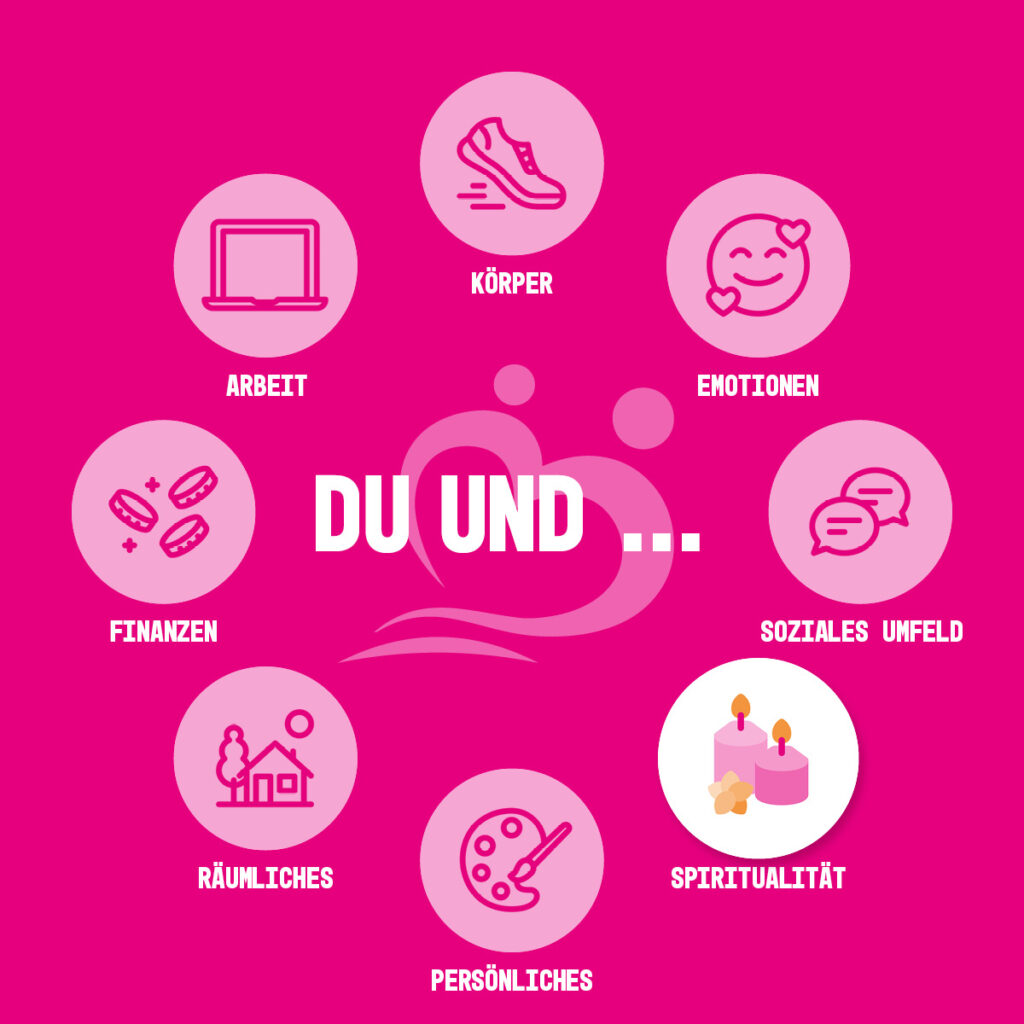
For all those who feel the same way, in December we will be looking at a special area of self-care: spiritual self-care.
Spiritual self-care refers to the cultivation of our own personal spirituality.
Spiritual mindfulness is about focusing not on the outer world, but on the inner world of the mind and soul by consciously taking care of our connection to the "big picture". The practice of spiritual self-care can include meditation, prayer, ritual acts, thanksgiving or even attending spiritual gatherings.
It is important to emphasize that spiritual mindfulness is a personal journey, and there are no set rules. Women can shape spiritual self-care according to their own needs, beliefs and time resources. Nevertheless, we would like to show one way in which we could combine spirituality and exercise. We would like to provide you with a step-by-step guide for a "walking meditation" that you can fill with spiritual content according to your personal preferences.
And this is how "walking meditation" works:
- Preparation:
Wrap up thick and comfortable. Go outside into nature and find a quiet path that is easy to walk on (preferably in the countryside). - Start calm and focused:
Start by standing still for a moment and concentrating on your breathing. Center your attention on the present moment, on nature, your body and your sensory perceptions. - Set a spiritual focus:
Choose a mantra or prayer that is personally meaningful to you. This could be a spiritual affirmation, a short prayer, a thanksgiving or a mantra from your own tradition or belief. What is currently on your mind? What do you want to say to yourself? Is there something you are grateful for? What would you like to focus your thoughts on? - Go consciously step by step:
Start walking very slowly and focus your attention on every step you take. Be aware of every step: How does the ground feel under your feet? What are your legs and arms doing? How is your posture? It is important to emphasize that the type of movement is less important than the conscious attention you pay during it. - Breathe consciously:
Let your breath flow, breathe in deeply. Adopt the rhythm of your steps for your breathing. For example, you can breathe in for three steps and then breathe out for three steps. Maintain this rhythm. - Integrate your thank you, mantra or prayer:
Repeat the mantra or prayer quietly in your mind as you walk. Focus your attention on the words and create a rhythm between your steps and your belief. - Stay mindful:
Remain aware of your surroundings. Be aware of sounds, smells and visual impressions as you walk along. Just notice all of this, do not evaluate your impressions. - Thought acceptance:
If your thoughts wander, gently bring your attention back to walking and to the belief. Accept the thoughts without judgment or pressure. - Conclusion:
Continue the walking meditation for as long as you like. Find a conclusion by standing still again for a moment. Feel the changes in your body and mind after this combination of conscious movement and your spiritual time.
Tip:
Adapt the practice to your own preferences and experiment to find out how you can best combine these elements. Experiment with different approaches and find out which movement sequences and beliefs best suit your own spiritual path. Any physical activity can become a spiritual experience if you approach it with mindfulness and an open mind.
Tip:
You can find out more about mindfulness in this short interview: